
10 Customer Retention Strategies That Can Increase Revenue Without Finding More Customers

How to Increase the Value of Every Customer Without Being Pushy

One sale can look successful, but it does not show the full picture. Customer lifetime value estimates what a buyer may contribute across the entire relationship, not just through one purchase. It gives you a clearer view of loyalty, retention, and future revenue.
Amanda Downie and Teaganne Finn describe this measure as an organization-wide view of the benefit a customer provides over time. That perspective helps you connect marketing, service, sales, and repeat purchases. It also turns a complex relationship into a practical metric for daily decisions.
In this guide, you will explore formulas, examples, data needs, common errors, and strategies for stronger growth. Small businesses throughout the United States can use these insights to plan smarter campaigns and protect profitable relationships. If you are serious about growth, call Sales Solved for practical marketing guidance.
Key Takeaways
- See why repeat business matters beyond a single sale.
- Connect retention, loyalty, revenue, and long-term planning.
- Learn how to estimate lifetime value with useful data.
- Spot errors that can weaken your calculations.
- Use the results to guide marketing and sales decisions.
- Get support from Sales Solved, serving small businesses nationwide.
What Is customer lifetime value?
Customer lifetime value shows the total financial worth of one buyer across the full relationship with your company. It includes every potential transaction during that time, rather than focusing on a single order. CLV, CLTV, and LTV are common names for this broad business measure.
How CLV measures the full customer relationship
To measure customer value, look at repeat purchases, renewals, engagement, and the length of the account. These signals reveal how loyalty and retention shape revenue. They also help you see whether strong service leads to ongoing business.
Historic CLV records what an existing buyer has already spent. For example, someone who buys a $40 Christmas tree from the same grower for 10 years creates $400 in historic lifetime value. Predictive CLV estimates what that buyer may spend in the future.
Why revenue from one purchase does not tell the whole story
A single sale misses future orders and renewals. It also separates financial results from softer signals, such as satisfaction or intent to recommend. Those signals matter, but CLV focuses on measurable dollars created throughout the relationship.
Why customer lifetime value matters to your small business
Rising acquisition costs make loyal buyers more important to your bottom line. In e-commerce, new-buyer acquisition costs climbed 222% over eight years. That increase can reduce profit, especially when a small business must compete with larger companies.
Customer lifetime value helps you focus on retention, not just immediate sales. It can reveal churn risks before lower renewals or weaker engagement hurt revenue. Salesforce reports that 42% of sales leaders rank recurring revenue as their top source.
Service quality also shapes loyalty. Salesforce found that 40% of buyers stopped purchasing from a brand in the past year because of inconsistent quality. Qualtrics reports that five-star experiences make people more than twice as likely to buy again, while 80% of satisfied consumers will spend more.
- Protect profit by strengthening existing relationships.
- Use the lifetime value number to guide marketing and retention plans.
- Find service gaps before they lead to churn.
If you are serious about growth, call Sales Solved. We help small business owners across the United States turn this insight into practical action.
Historic and predictive customer lifetime value models
Two CLV models give you different views of financial performance. One confirms what happened, while the other estimates what may happen next. Together, they support smarter planning for your business.
Using historic CLV to understand past customer value
Historic CLV records confirmed spending from an existing buyer. It works well for companies with clear purchase records. For example, a $40 Christmas tree purchased once each year for 10 years produces $400 in historic CLV.
This model is simple, transparent, and easy to review. It shows which accounts have already generated strong returns. However, it cannot show future purchases or changes in buying behavior.
Using predictive CLV to forecast future revenue
Predictive CLV uses historical data and an algorithm to estimate relationship duration and future revenue. The calculation may include purchase frequency, an expected retention rate, acquisition costs, and business overhead.
Its forecast helps you decide where to invest in loyalty, service, or onboarding. The right model depends on business size, pricing consistency, buying patterns, and available records.
- Use historic CLV for confirmed results.
- Use predictive CLV for planning and growth.
- Review forecasts as new data arrives.
How to calculate customer lifetime value

Reliable forecasting starts with a few clear inputs. You can calculate customer lifetime value by linking spending patterns to relationship length, then adjusting the result for service costs.
The basic formula
The core formula is CLV = customer value × average customer lifespan. This simple model gives you a useful base for planning revenue and retention efforts.
Calculating average spending and purchase frequency
First, find the average purchase amount. Then multiply it by the average number of purchases in a year. This produces average revenue per buyer. CRM records and e-commerce analytics can make each input more accurate.
Accounting for lifespan, margins, and costs
Suppose a buyer spends $10,000 each year for five years. Gross CLV equals $50,000. After $15,000 in service costs, net CLV falls to $35,000.
An expanded formula is CLV = average revenue per buyer × lifespan − total costs to serve. Advanced models may also include gross margin, acquisition cost, discounts, and variable expenses. Use a consistent rate and review the number each year.
| Measure | Formula | Example |
|---|---|---|
| Average buyer value | Purchase amount × frequency | $10,000 per year |
| Gross CLV | Annual revenue × five years | $50,000 |
| Net CLV | Gross CLV − service costs | $35,000 |
Customer data and metrics you need for an accurate CLV
Strong forecasts depend on clean records, not guesswork. Start with average purchase value, purchase frequency, lifespan, churn rate, and profitability. Together, these figures show how much revenue an account may produce and what it costs to serve.
Tracking revenue, retention, adoption, and engagement
Next, add signals that show future buying potential. User adoption, renewal history, product expansion, and support activity can reveal risks early. Login frequency, event attendance, active users, and feature adoption also help measure engagement.
- Compare revenue with service costs for a clear profitability score.
- Watch churn rate and renewal patterns to assess retention.
- Use engagement metrics to spot inactive accounts.
- Review product usage before planning outreach.
Sales Cloud can bring revenue, product usage, service history, and feedback into one system. This reduces scattered spreadsheets and gives your company a clearer view of account health. With reliable data, you can segment accounts, prioritize support, and make CLV decisions with evidence. Better records lead to better planning.
| Data point | What it shows | How to use it |
|---|---|---|
| Purchase frequency | Buying habits | Estimate future revenue |
| Churn rate | Loss risk | Plan retention work |
| Adoption rate | Product use | Guide account support |
| Profitability score | Revenue minus costs | Prioritize valuable accounts |
Customer lifetime value examples across different businesses
Different industries create revenue in very different ways. These examples show how purchase frequency, pricing, and relationship length shape the final number.
| Business | Calculation | CLV |
|---|---|---|
| Coffee shop | $5 × 100 visits × 5 years | $2,500 |
| Subscription service | $20 × 12 payments × 4 years | $960 |
| Car dealership | $40,000 × 0.2 purchases × 15 years | $120,000 |
For a coffee shop, frequent visits build a strong customer lifetime total from modest orders. A subscription company earns steady revenue through monthly billing. The dealership sees fewer transactions, yet each product creates a much larger return over the relationship.
There is no universal CLV benchmark. Adapt the formula to your pricing model, purchase cycle, retention rate, and expected relationship length. Then compare results by segment, not by industry alone.
Use these examples as a starting point for your company. Review actual buying records each year, account for service costs, and update your forecast when customer behavior changes. The right context makes the number useful.
How CLV differs from CAC, NPS, and CSAT
Different business metrics answer different questions. Customer lifetime value connects a buyer’s full relationship with your company to financial revenue. CLV supports profit planning, while other measures explain behavior or satisfaction.
Comparing lifetime value with customer acquisition cost
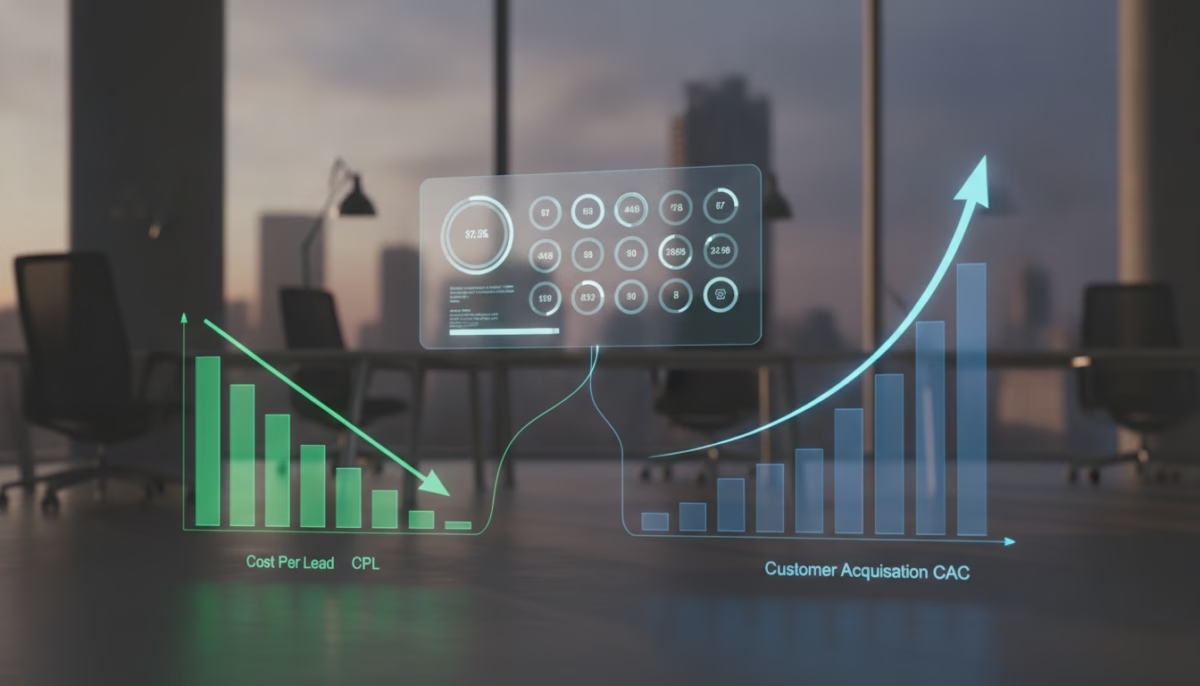
Acquisition cost includes advertising, marketing, special offers, and other efforts used to win a new buyer. Compare that cost with CLV to judge campaign performance. For example, a coffee shop with a $1,000 CLV can lose money when acquisition costs exceed $1,000 per person.
Include service costs, support expenses, product quality, and retention when estimating net profit. This view shows whether your products and service create healthy returns over time.
Understanding retention and satisfaction metrics
NPS asks how likely someone is to recommend a product or service through one question. CSAT measures satisfaction at a specific touchpoint, such as checkout or support. Neither metric can show the total financial value of the relationship alone.
Use NPS and CSAT beside CLV. Their signals can explain why lifetime value rises or falls and help companies improve the customer experience.
Common customer lifetime value mistakes to avoid

A profitable-looking account may hide expenses that change the result. When you calculate customer lifetime value, subtract acquisition spending, service costs, overhead, and operating resources. Revenue alone can create a misleading picture.
Cost to serve may include delivery, store or office overhead, contact-center support, and logistics. For a paid television subscription, first-year support and setup costs may be high. Those costs can fall as the relationship continues.
Renewal-rate declines create another warning sign. Fewer renewals can raise the average service cost and reduce profit. Track churn each month, then investigate the cause before the trend grows.
A single average can also hide important differences. Compare high-value and low-value segments instead of treating every buyer alike. Use accurate data, shared definitions, and clear actions. CLV is most useful when it guides decisions, not when it sits in a report.
- Include acquisition and operating costs.
- Review first-year service patterns.
- Monitor churn and renewal rates.
- Compare segments before setting budgets.
| Mistake | Risk | Better practice |
|---|---|---|
| Counting revenue only | Profit appears inflated | Subtract all relevant costs |
| Using one average | Segments remain hidden | Compare buyer groups |
| Ignoring churn | Renewal losses go unnoticed | Review rates monthly |
Strategies to increase customer lifetime value
Practical growth starts with fewer obstacles after the first sale. When buyers understand your product, receive timely help, and see relevant offers, they have more reasons to stay with your company. These strategies can improve customer lifetime value without adding waste to your marketing budget.
Improve onboarding, service, and the customer experience
Make onboarding simple with clear instructions, delivery details, and return policies. Proactive emails can answer questions before they become problems. Offer support through phone, email, social media, and chatbots to reduce friction. Qualtrics found that five-star experiences make people more than twice as likely to buy again.
Use loyalty programs and personalized marketing
Reward repeat purchases with points, discounts, free shipping, or exclusive access. Personalize marketing with search history and past orders. A free-shipping threshold can also encourage larger carts. These efforts build loyalty while giving shoppers a clear reason to return.
Increase revenue through upselling and cross-selling
Recommend useful upgrades or related products at the right time. Sales leaders report that upsells and cross-sells produce 31% of revenue. Focus on fit, not pressure. Satisfied consumers are also willing to spend more, making these tactics a strong path to sustainable growth.
How to apply CLV insights to retention and growth
Turn account history into action with customer lifetime value insights. Review spending, product adoption, expansion, engagement, renewal history, and feedback together. This wider view shows where loyalty is strong and where support may prevent loss.
Begin with a simple account review. A long-standing buyer who spends $10,000 each year may still face future-risk if product expansion and event participation stop. In contrast, a newer buyer with a small contract may gain strong lifetime value after adding two solutions within 18 months.
Identify high-potential accounts and churn risks
Watch for decreased spending, lower usage, missed check-ins, complaints, and rising support cases. Mergers, acquisitions, and strategic changes can also shift priorities. These insights help you plan timely outreach and protect the relationship.
- Rank the base by revenue, adoption, and renewal strength.
- Use account insights to guide support and expansion.
- Review feedback before a churn signal becomes a clear loss.
- Compare customer lifetime value with service effort.
Sales Cloud can unite sales, service, product-usage, revenue, and feedback data. AI-powered CRM tools can flag churn risks and suggest next-best actions. Use these insights to improve retention, loyalty, and steady growth.
Grow Your Small Business With Sales Solved
Clear data can help you make better decisions for your small business. Customer lifetime value shows where repeat buying, strong service, and lasting loyalty can support steady revenue.
Sales Solved serves small business owners throughout the United States. Our team connects CLV insights with practical sales and marketing plans. You can focus on strong accounts, improve retention, and reduce churn before losses grow.
A focused plan may also lower service waste and help stabilize cash flow. Your company can use purchase history, engagement data, and sales records to find better opportunities. These steps create a stronger foundation for long-term growth.
- Identify accounts with strong growth potential.
- Use data to improve retention and outreach.
- Reduce churn with timely, useful support.
- Turn insights into measurable sales results.
If you are serious about growth, call Sales Solved. We help you turn lifetime value analysis into practical action. For your business, choosing our team may be the best marketing decision you make.
Conclusion
Smart growth begins with a wider view of each buying relationship. Customer lifetime value shows revenue beyond one transaction. Historic and predictive models reveal past results and likely future patterns.
Use purchase frequency, relationship length, acquisition cost, service expense, margins, and profit when you build the formula. Clean records make the estimate more useful and help you set sound budgets.
Next, connect the insight to action. Improve onboarding, service quality, personalization, expansion offers, retention, and loyalty. These steps can protect margins and create steadier revenue as your business grows.
Sales Solved serves small business owners across the United States. If you are serious about growth, call us. We can help you turn data into a clear plan. Choosing Sales Solved may be the best marketing decision you make.