

What Should Be on a Small Business Marketing and Sales Dashboard?

Marketing Isn’t the Problem: How to Find the Real Bottleneck in Your Sales Growth
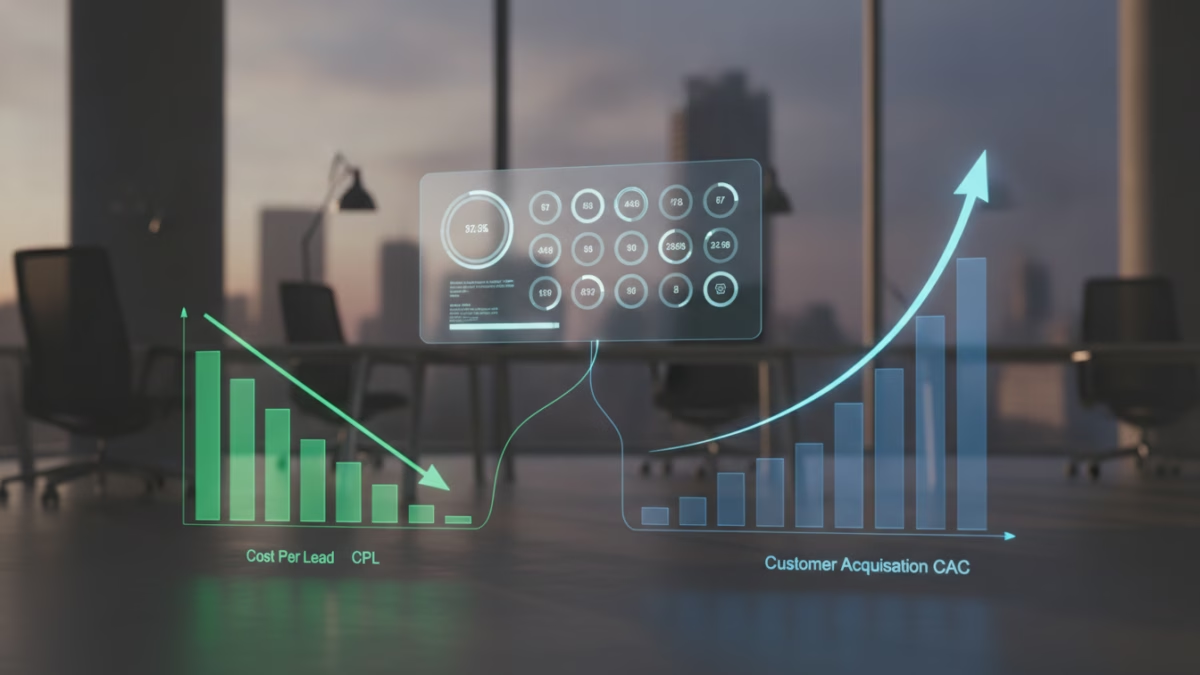
Growth decisions become clearer when you know what each metric shows. The June 27, 2025 update explains how cost per lead vs customer acquisition cost helps you read your marketing funnel with greater precision.
A simple example makes the difference clear. A $10 inquiry from a $5,000 campaign may look strong at first. Yet a $100 result that brings a paying buyer can create more revenue and stronger returns. Early interest is not the same as a sale.
You will see how conversion rates, lifetime value, profit, and budget goals shape the right decision. CPA can help you judge campaign efficiency, while CAC shows the broader picture across sales and marketing.
For small-business owners across the United States, Sales Solved offers practical marketing guidance. If you are serious about measurable growth, call Sales Solved and make a confident marketing decision for your business.
Key Takeaways
- One metric tracks early interest; the other reflects new buyers.
- A low inquiry figure does not always signal strong performance.
- Conversion rates connect campaign activity with revenue.
- Lifetime value can change how you judge results.
- Smart budget choices rely on profit, not one number alone.
- Sales Solved supports measurable growth across the United States.
Understanding cost per lead vs customer acquisition cost
These figures answer different questions about your marketing engine. One shows how much you spend to create early interest. The other connects that effort with a new buyer. Used together, they give your business a clearer view of performance.
Why these metrics matter to your growth strategy
Businesses track CPL and CAC as key performance indicators, not interchangeable numbers. CPL can cover days, months, quarters, years, or a custom time range. That choice may change how you read campaign results. A short period may reveal a sudden shift, while a longer view can show a steady trend.
Channel data helps you set a practical budget. Broader economics guide your growth plan and reveal whether new buyers support healthy returns. CPA offers another view of campaign efficiency, while CAC reflects the full process from outreach to purchase.
Where CPL and CAC fit in the marketing funnel
CPL sits near initial interest, such as a form fill or call. CAC appears later, when a lead becomes a paying customer. For reliable decisions, Compass East recommends accurate financial and operational data. Clean records help you compare campaigns, spot waste, and improve marketing choices with confidence.
What Cost Per Lead Measures
This metric shows how much your marketing budget produces in early interest. It helps you compare audience response, traffic sources, and campaign efficiency before sales results appear.
Cost Per Lead Formula and Calculation Example
Use this formula: total marketing spend ÷ generated inquiries. For example, a $5,000 campaign that brings 500 leads produces a cost per lead of $10. A real estate agency spending $2,000 on 100 inquiries records $20 for each result.
How Lead Quality Affects CPL Performance
A low figure does not always show strong performance. An Instagram campaign that spends $2,500 for 500 leads records $5 each. However, five leads from the same budget creates a $500 result and signals a targeting problem.
Review intent, ad quality, and conversion data across channels. Strong targeting can attract people who need your offer now. This makes the metric more useful for SaaS, real estate, financial services, and higher education.
| Scenario | Spend | Inquiries | Result |
|---|---|---|---|
| General campaign | $5,000 | 500 | $10 each |
| Real estate | $2,000 | 100 | $20 each |
| Instagram, strong response | $2,500 | 500 | $5 each |
| Instagram, weak response | $2,500 | 5 | $500 each |
How Customer Acquisition Cost Reflects Growth

Profit becomes easier to judge when you track the full path from outreach to a new buyer. CAC measures the sales and marketing investment needed to gain one customer, not just the price of one advertisement. It connects spending with revenue and long-term growth.
Customer acquisition cost formula and included expenses
Use this formula: total sales and marketing costs divided by new customers gained. Include salaries, software licenses, creative work, paid media, events, sponsorships, agency fees, demonstrations, and samples. Reliable data gives your business a more accurate view of profitability.
For example, $10,000 spent over six months to gain 200 customers creates a $50 CAC. A larger company that spends $100,000 in one month and gains 500 customers records a $200 CAC. Time frame and scale can change the result.
Compare CAC with lifetime value (LTV). A $2,000 LTV and $900 CAC show positive economics. A $2,200 CAC signals a loss because the investment exceeds expected revenue.
| Scenario | Sales and marketing spend | New customers | CAC result |
|---|---|---|---|
| Six-month example | $10,000 | 200 | $50 |
| Monthly scale example | $100,000 | 500 | $200 |
| Positive LTV case | $900 CAC | $2,000 LTV | Positive economics |
| Loss-making LTV case | $2,200 CAC | $2,000 LTV | Negative economics |
Cost Per Lead vs Customer Acquisition Cost: Key Differences
Numbers can look similar while telling very different stories. The right comparison depends on where an action occurs in your sales funnel and what decision you need to make.
Leads versus paying customers
A contact shows interest, but it does not confirm revenue. For example, paid search may deliver a $20 CPA from $5,000 and 250 leads. That result reveals campaign activity, yet it does not prove that those contacts will buy.
Tactical campaign efficiency versus strategic profitability
CPA helps you compare ads, audiences, and landing pages. It can measure a form, download, sale, or another chosen response. Use it to adjust a channel and protect your budget.
CAC offers a wider business view. It includes marketing work, sales time, software, and other operating expenses tied to growth. A healthy CAC supports profit and sound planning, while a low CPA may only show strong early response.
Early-funnel metrics versus full-funnel costs
Early figures guide quick tests. Full-funnel results show whether the entire model works. Review both metrics at each stage before judging performance.
When Cost Per Lead Is the Better Metric
Some buying journeys need patience before revenue appears. When your business educates, qualifies, and nurtures prospects, early response can reveal whether your marketing is building a useful pipeline.
Long sales cycles and lead nurturing
B2B firms often guide prospects through several reviews, demos, and approvals. In this setting, cost per lead helps you measure interest while your sales team continues the process. It also gives you time to assess source quality instead of judging results too soon.
Email lists, retargeting, content marketing, and search ads support this approach. A B2B software company may accept a $100 CPA or more for a qualified prospect with strong buying intent. An affordable contact has less value if that person never engages again.
- Track inquiry volume by source.
- Review engagement during nurturing.
- Compare qualified prospects with total traffic.
- Give longer campaigns enough time to mature.
Focus on progress, not price alone. Your business can use these strategies to refine audiences, improve messages, and protect campaign quality while future revenue develops.
| Use case | What to monitor | Why it helps |
|---|---|---|
| B2B software | Qualified inquiries | Supports long reviews |
| Email nurturing | Opens and replies | Shows ongoing interest |
| Retargeting | Return visits | Reaches warm audiences |
When Customer Acquisition Cost Matters More

Revenue goals often require a closer look at what happens after someone responds. When purchases, bookings, or subscriptions matter now, CAC shows whether your marketing creates profitable demand.
Direct sales and immediate revenue goals
CPA measures the cost per acquisition for a sale or sign-up. An online store may target a CPA below $30 for a $100 product. Margin, shipping, refunds, and order value still shape the final result.
Subscription brands should compare acquisition spending with one month of recurring revenue. Travel and hospitality teams can compare booking value with campaign spending. These checks show whether a paying customer supports healthy revenue.
Evaluating sustainable customer growth
CAC matters most when you need proof that new buyers create more value than they require. Compare CAC with lifetime value to assess profitability. A strong ratio supports steady growth, while a weak ratio calls for new sales strategies.
- Review CPA against margin.
- Compare bookings with total cost.
- Track recurring revenue after sign-up.
| Business model | Key measure | Decision signal |
|---|---|---|
| E-commerce | CPA below $30 | Margin supports sales |
| Subscriptions | Monthly revenue | Recovery looks realistic |
| Travel and hospitality | Booking value | Demand supports growth |
How CPL and CAC Work Across Channels and Campaigns
Your results can shift sharply when you compare email, direct mail, SMS text, telemarketing, paid search, paid social ads, and personalized landing pages. Each channel reaches a different audience and supports a different stage of the buying journey.
For example, a paid search campaign with $5,000 in spend and 250 leads produces a $20 CPA. That figure helps you judge campaign performance, but it does not show whether those contacts become buyers.
Email, social media, and paid advertising should each receive separate tracking. One source may bring inexpensive traffic, while another sends fewer but better-qualified prospects. Quality often matters more than volume.
- Review response rates by channel.
- Measure sales after each campaign.
- Compare acquisition cost with revenue.
Use channel data to guide time and budget decisions. E-commerce, subscription services, and travel companies often focus on CPA. Your business should also review customer acquisition and CAC to confirm that marketing activity supports healthy growth.
| Channel | Best tracking focus | Typical decision |
|---|---|---|
| Replies and sales | Improve message timing | |
| Paid search | CPA and conversion | Refine targeting |
| Paid social | Traffic quality | Adjust audience signals |
| SMS text | Response and bookings | Test offer timing |
Using LTV, Conversion Rates, and Revenue to Judge Efficiency
A campaign earns attention only when that attention supports sales and lasting revenue. Review conversion data with broader financial signals before you judge performance.
Comparing lifetime value with CAC
Lifetime value estimates total revenue from one buyer throughout the relationship. Your estimate should include purchase frequency, average order value, retention rate, and gross margin. The common 3:1 LTV-to-CAC benchmark offers a useful guide for sustainable profitability.
For example, a $200 CAC should generally support at least $600 in LTV. A $2,000 LTV with $900 CAC can support profit. In contrast, $2,000 LTV with $2,200 CAC signals a loss.
Why conversion rate changes the meaning of CPL
A low CPL may look attractive, yet its meaning changes when few inquiries become buyers. A campaign with a $10 CPL and a 2% conversion rate may create less revenue than a $30 CPL campaign with a 15% rate. Use conversion data, sales results, and cost per acquisition together.
- Check inquiry quality.
- Track buyer conversion.
- Compare LTV with CAC.
| Measure | Example | Meaning |
|---|---|---|
| LTV | $600 | Supports $200 CAC |
| CAC | $900 | Healthy with $2,000 LTV |
| CAC | $2,200 | Loss against $2,000 LTV |
Strategies to Lower Marketing Costs and Improve Profitability
Small changes across your funnel can improve returns without increasing traffic. Start with the audience, message, and page experience, then use results to guide your budget.
Improving targeting, creative, and landing page conversions
Use audience targeting to reach people with a clear need. Test headlines, offers, images, and calls to action. A mobile-friendly landing page and A/B testing can lift conversion rates without more visitors.
Retargeting, automated bidding, and attribution analysis help you shift funds toward strong campaigns and channels. These steps can lower CPA and improve overall campaign performance.
Strengthening lead qualification and sales alignment
Lead scoring helps sales teams focus on qualified prospects, not every inexpensive inquiry. Shared goals between marketing and sales can shorten delays and reduce wasted effort.
Using automation, content marketing, and referrals
Helpful content, referrals, and workflow automation support efficient growth. Taylor’s personalized omnichannel strategies show how retail, financial, and automotive brands can guide each customer journey.
Sales Solved is a growth-focused choice for small-business owners across the United States. Call when your business is serious about stronger profits.
| Strategy | Primary action | Expected benefit |
|---|---|---|
| Targeting | Refine audience signals | Higher-quality inquiries |
| Testing | Compare page variations | More conversions |
| Automation | Streamline follow-up | Shorter sales cycles |
| Referrals | Encourage trusted introductions | Stronger buyer value |
Conclusion
CPL shows how efficiently your marketing creates early interest. CAC reveals the wider investment needed to gain a paying customer. Neither metric stands alone. Review both across the funnel, then connect them with conversion rates, sales results, and revenue.
Strong decisions also rely on lead quality, lifetime value, and accurate data. A low cost per lead has limited meaning when prospects do not move forward or create enough value. Your CPA can guide campaign changes, while CAC helps you judge sustainable growth.
Every business and industry needs useful context. Compare results over time, review channel quality, and protect your profit goals. Clear measurement turns marketing activity into confident action.
Sales Solved serves small-business owners throughout the United States. If you are serious about growth, call Sales Solved today and make the stronger marketing decision for your business.