

Creating Visual Content That Captivates Your Audience

Leveraging Customer Feedback to Improve Your Products and Services

Pay-per-click (PPC) advertising boosts small businesses. It helps them meet marketing goals and grow. PPC is key to making a big impact online with a limited budget. It’s vital to measure success accurately to ensure money spent on ads gives a good return.
Using PPC that focuses on local needs can really pay off. This includes reaching the right customers and using data to make smart choices.
Mastering PPC Advertising with paid search can change the game for small business. Those who truly understand how to get the most from ads will shine.
Key Takeaways
- PPC advertising offers small businesses targeted reach and measurable results, making it a valuable tool for their digital marketing efforts.
- Accurately measuring PPC performance is crucial for maximizing ROI, especially for small businesses with tight budgets.
- Proposing PPC strategies that cater to the specific needs of local businesses can lead to significant benefits.
- Mastering digital marketing through effective PPC can be transformative for small businesses.
- Agencies that demonstrate a strong understanding of ROI and maximizing returns will stand out in the competitive landscape.
Understanding the Importance of PPC Advertising for Small Businesses
Small businesses now face a tough digital market. That’s where PPC (pay-per-click) advertising comes in, boosting growth and ROI. Thanks to targeted reach and measurable results, it’s a key part of their marketing.
PPC Offers Targeted Reach and Measurable Results
Precise targeting options in PPC ensure ads hit the right people at the right time. This boosts visibility and impact. With tracking and analysis, businesses can make smart choices to get better ROI. They use these insights to up website traffic, boost sales, and enhance their brand image.
PPC Enables Data-Driven Decision-Making for Optimal ROI
PPC’s measurable results and tracking let small businesses dive into marketing data. This info helps tweak strategies by watching key stats like clicks and costs. With a sharp eye on these numbers, businesses make decisions that lead to successful campaigns and optimal ROI.
Setting Clear Goals and Objectives for Your PPC Campaigns
It’s vital for small businesses to set clear goals for their PPC campaigns. These goals should include lead generation, sales, website traffic, or increasing brand awareness. The SMART goal approach helps align our PPC strategies with our main business goals. This makes every campaign more valuable and ensures they help increase our ROI.
Define Specific Metrics for Measuring Success
We need to know what success looks like for our PPC campaigns. This includes looking at metrics like click-through rates (CTR) and how many people turn into leads. These metrics help us make smart, data-based decisions. They let us tweak our strategies to get the best value from our investment.
Align PPC Strategies with Business Goals
Linking our PPC efforts to our business’s big goals is key for success. Whether we want to raise online sales by 10% in three months or boost brand awareness with ads, our PPC campaigns should support these goals. Setting realistic timelines and budgets helps us keep on track. This way, we can see exactly how our PPC work is paying off.
PPC campaigns need goals that are clear, specific, and realistic to succeed. Mixing in both short and long-term targets keeps us focused and driven. It also lets us keep improving our PPC plans. It’s also important to regularly check how we’re doing against our goals. This helps us understand what’s working well and where we can make our campaigns even better.
Keyword Research: Targeting the Right Keywords for Maximum ROI
Choosing the correct keywords is key to making your PPC campaigns work. By using tools like Google Keyword Planner and SEMrush, you can find keywords that are likely to bring you more sales. These are keywords that fit your business well.
Utilize Tools for Keyword Discovery
Keyword discovery tools give us important information. This includes how many people search for a keyword each month, how hard it is to rank for, and its cost. With this data, we can pick the right broad match, phrase match, and exact match keywords to use in our ads. These choices help us meet our goals and connect with the right people.
Incorporate Broad, Phrase, and Exact Match Keywords
It’s smart to use a mix of broad match, phrase match, and exact match keywords. This way, our ads are shown to more people but still remain relevant to their search. We cover a wide range of searches and the more focused, precise types as well. Eventually, this brings more quality visitors to our site, boosting our success rates.

Choosing the best keywords improves how well our campaigns do. It brings better visitors to our site. And in the end, it helps us earn more from our PPC efforts. Keep improving your keyword strategy for the best results.
Optimizing Ad Copy, Landing Pages, and PPC Advertising
Crafting ad copy that grabs your audience’s attention is key to effective PPC campaigns. We focus on using language that spurs action, pointing out what makes you unique. Testing various ad versions helps find the most successful. This lets us constantly improve your ad copy.
Craft Compelling Ad Copy with Clear Call-to-Actions
Our talented copywriters will team up with you to create powerful ad text. They use the art of ad copy optimization to make ads that really stand out. These ads explain why you’re special and encourage people to visit your site or fill out a form.
Align Landing Pages for Seamless User Experience
Getting your landing pages right can boost your PPC results. We aim to make them inviting and easy, guiding visitors towards the actions you want them to take. By making your landing pages match your ad copy, we ensure a smooth user experience. This lifts your ad score and improves your chances of more clicks and leads.
With careful tweaking of ad content and landing pages, we’ll help you see better results from your PPC efforts. Our strategy is all about using data and fine-tuning every detail. This way, your PPC ads are set up for real success.
Testing, Analyzing, and Continuous Improvement
To get the most from your ad money, it’s key to often test and analyze your PPC campaigns. Use A/B testing not just for ads but also for how you bid, who you target, and the extra details you show. Look at numbers like click-through rates, conversion rates, and cost-per-acquisition to see what works best and what needs a boost.
Adjust your PPC ads as you gather new data to better them. This way, we can make our strategies better, bring in more buyers, and see bigger profits from our ads. Be sharp and ready to change with the digital world to beat the competition.
Implement A/B Testing for Ad Variations
A/B testing helps us check how different ad parts perform, like headlines, pictures, what you ask folks to do, or the first page they see. By trying out different versions equally, we find what really works. This lets us make smart choices to do better in our ads.
Analyze Data and Metrics for Optimization
With tools like Google Analytics, we keep a close eye on important numbers in our ads, such as click rates, how many sales we make, and what it costs to get a new customer. Using numbers this way helps us find what’s good and what could be better. Then we can make choices that are right based on all this info to make our ad plan the best it can be.
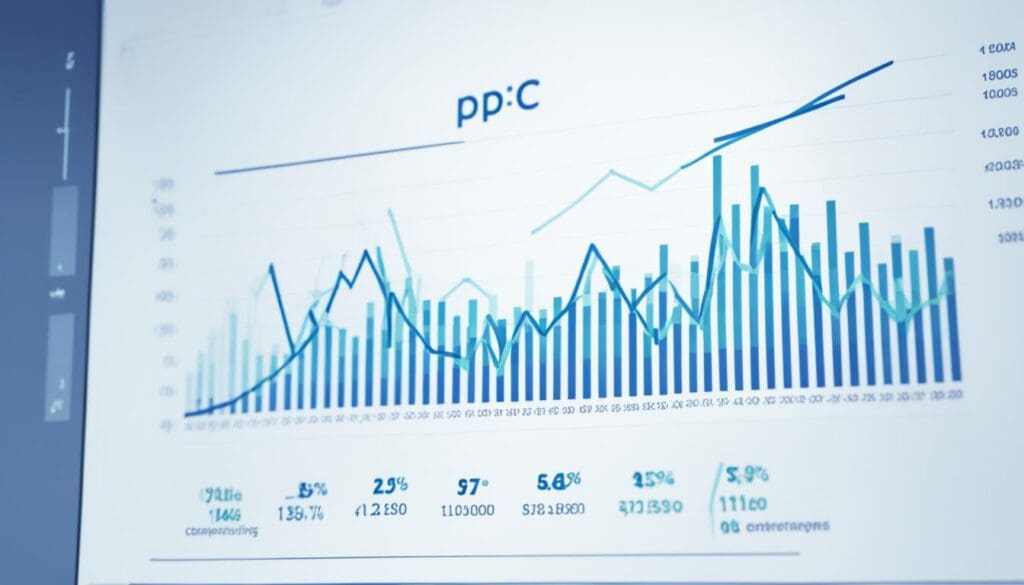
Advanced PPC Strategies for Small Businesses
To make your PPC campaigns work better, think about adding more advanced strategies. This includes retargeting, remarketing, geo-targeting, and demographic targeting. They let you aim more precisely at your target audience. This focus can help increase your return on investment (ROI).
Leverage Retargeting and Remarketing
Retargeting and remarketing help grab the attention of users who’ve already checked your website. Or they might have shown interest in what you offer. Putting targeted ads in front of them can boost your conversion rates and ROI. These methods work well with users who almost made a purchase but didn’t.
Utilize Geo-Targeting and Demographic Targeting
With geo-targeting and demographic targeting, you can aim your ads at specific places and people. Targeting this way helps you get the most out of your ad spending. It ensures your message reaches the right people, whether they’re in a certain area or part of a specific group.
Incorporate Mobile Optimization into PPC Campaigns
Being mobile-friendly is key because many people use their phones to browse the internet. Your ads, websites, and user experience should be great on mobile. This way, you catch the eye of busy consumers and encourage more interaction and sales.
For small companies, using these advanced PPC methods can help their ads stand out and beat the competition. Strategies like retargeting, remarketing, geo-targeting, demographic targeting, and mobile optimization can create a stronger, more successful PPC campaign. One that brings in better results and a good ROI.
Conclusion
Using the tips in this article can help small businesses succeed with PPC ads. Knowing the importance of PPC is key. It’s about having clear goals and picking the right keywords. Making the ads and landing pages better is crucial too.
Testing and checking how things are going is a must. This way, PPC can bring in good leads, make the business more visible online, and help meet growth goals.
Data and smart advertising choices are vital. They make sure small businesses’ PPC efforts pay off. To win at PPC, it’s important to always look for ways to improve. Working with a top digital marketing agency, like Solved, can make a big difference. They help businesses make the most of PPC, pushing them ahead.
PPC offers a fast and easy way to start advertising. Plus, its results are easy to see and follow. When combined with other marketing efforts, PPC can do wonders for a business.
Focus on finding the best keywords and making the ads better over time. Keep learning from what works and what doesn’t. This strategy will help get the most from PPC and outdo the competition.